War has shaped the fate of almost every nation, and Poland is no exception. Between the 10th and 20th centuries, Polish soldiers fought in dozens of major battles – some glorious victories, some bitter defeats, many with consequences far beyond Poland’s borders.
If you’re interested in history, these battles are not just dry dates from a textbook. Each one is a story about leadership, courage, bad decisions, lucky breaks and turning points that changed the map of Europe. Let’s walk through ten of the most important battles in Polish history and see what actually happened – and why it still matters today.
MEDIEVAL POLAND: FIGHTING FOR SURVIVAL AND RECOGNITION
Cedynia – 24 June 972
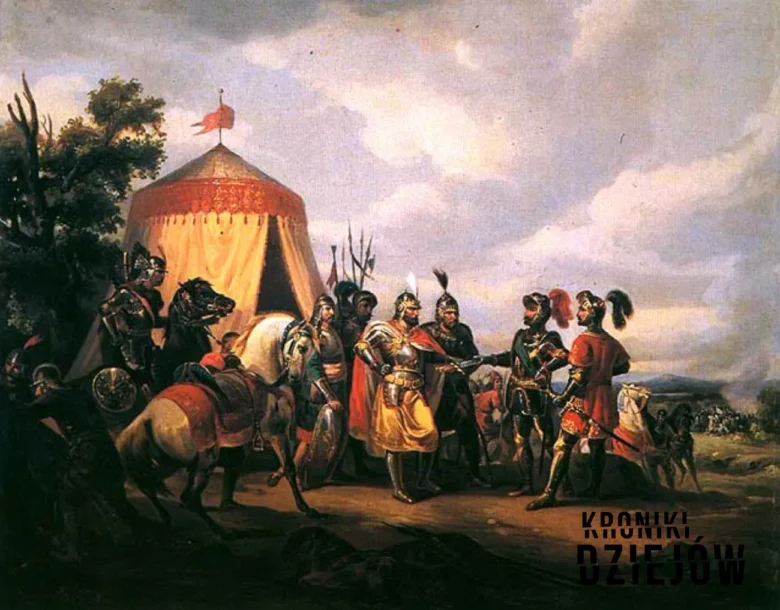
The battle of Cedynia is generally considered the first recorded clash between the early Polish state and a German margrave. Margrave Hodon led several thousand warriors into the lands of Mieszko I, probably expecting an easy campaign against a “young” state.
Mieszko had something more valuable than numbers: information and terrain. Warned in advance, he chose ground full of hills, woods and marshes near the village of Cedynia, perfect for an ambush. When the German forces approached, Polish troops attacked suddenly from higher ground. The surprise was so complete that Hodon’s army collapsed, suffering heavy losses.
The message was clear: Poland was not a fragile, temporary creation, but a rising power that Germany had to take seriously.
Mozgawa – 13 September 1195
The battle of Mozgawa was not a fight against a foreign invader, but a brutal civil war between rival Piast princes. On one side stood Mieszko III the Old with his allies from Greater Poland and Silesia; on the other side, Leszek the White and his Lesser Poland supporters, backed by Rus’ forces.
The clash was long and extremely bloody. Mieszko was badly wounded, his beloved son was killed, and both sides suffered tremendous casualties. In the end, there was no clear strategic winner. Political control over Kraków stayed roughly the same, but hundreds of knights never returned home.
Mozgawa is a sad reminder that internal conflicts can cost a country just as much as foreign wars – sometimes even more, because everyone loses.
Grunwald – 15 July 1410
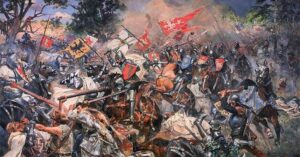
If you ask a Pole to name one battle from the Middle Ages, chances are they’ll say Grunwald. In 1410, the united forces of King Władysław Jagiełło of Poland and Grand Duke Vytautas of Lithuania faced the Teutonic Order, one of the most feared military powers of the age.
The battle was hard, chaotic and long. Lithuanian light cavalry attacked first, then heavy Polish banners joined the fight. In the end the Teutonic lines broke, their army was destroyed, and Grand Master Ulrich von Jungingen was killed.
Grunwald changed the balance of power in the region. The myth of the “invincible” Teutonic Knights disappeared, and the Polish-Lithuanian union became a major player in European politics.
Święcino – 17 September 1462
Święcino is far less famous than Grunwald, but strategically it was crucial. During the Thirteen Years’ War against the Teutonic Order, Polish commander Piotr Dunin faced a larger Teutonic army near the village of Święcino on the Baltic coast.
Dunin used defensive field fortifications and a wagon camp inspired by Hussite tactics. He let the enemy come closer, then launched a well-timed counterattack. The result was a decisive Polish victory and heavy losses for the Teutonic Order.
This battle helped turn the tide of the war and paved the way for the Second Peace of Toruń, which returned Gdańsk Pomerania and access to the sea to the Polish Crown.
EARLY MODERN ERA: FROM EASTERN WARS TO DEFENDING EUROPE
Połock – 11–30 August 1579
In the late 16th century, the Polish-Lithuanian Commonwealth fought the Tsardom of Russia for control over Livonia. King Stephen Báthory decided not to wait passively and launched an offensive, targeting the strong fortress of Połock.
The siege was difficult. Rain, mud and strong defenses slowed everything down. Only when Polish artillery managed to set wooden fortifications on fire did the defenders’ morale break. Połock surrendered, and Báthory followed up this success with more campaigns that eventually forced Russia to sign peace and give up its gains.
Połock shows how methodical, well-planned operations can slowly turn a bad strategic situation into a favourable one.
Kłuszyn – 4 July 1610
At Kłuszyn, Polish hetman Stanisław Żółkiewski faced an army of Russian and Swedish troops several times larger than his own. On paper, it looked like a suicide mission.
Instead of retreating, Żółkiewski relied on discipline and the shock power of the famous Polish hussars. For hours, his cavalry performed repeated charges, breaking successive enemy formations. Against all expectations, the larger coalition army was crushed.
The victory opened the road to Moscow, where Polish forces briefly gained enormous influence. Kłuszyn is often cited as one of the finest examples of how superior training and leadership can overcome numerical inferiority.
Chocim – 11 November 1673
In 1673, the Polish-Lithuanian army under hetman Jan Sobieski attacked Ottoman forces near the fortress of Chocim. It was cold, the terrain was difficult, and morale on both sides was under pressure.
Sobieski carefully prepared a dawn assault. Polish infantry broke into the Ottoman camp, and soon heavy cavalry, including hussars, charged through the gaps in the fortifications. The Ottoman army suffered a devastating defeat and lost thousands of men.
This spectacular victory made Sobieski a national hero. A year later he was elected king – proof that a single brilliant campaign can change not only history, but also the career of one man.
Vienna – 12 September 1683
Ten years later, as King John III Sobieski, the same commander rode to the rescue of Vienna, besieged by a huge Ottoman army. The fate of Central Europe was at stake.
After a day of fighting, the decisive moment came when a massive allied cavalry charge rolled down from the hills straight into the Ottoman lines. Polish hussars played a leading role. The Ottoman army broke, the siege was lifted, and the advance of the Ottoman Empire into Europe was stopped.
For many historians, Vienna was not only a Polish victory, but also a turning point for the whole continent.
THE 20TH CENTURY: DEFENDING INDEPENDENCE
Battle of Warsaw – from 16 August 1920
After regaining independence in 1918, Poland quickly found itself at war with Bolshevik Russia. By summer 1920, Soviet armies were approaching Warsaw, dreaming of carrying the revolution into Germany and beyond.
Polish command, led by Józef Piłsudski, prepared a bold counteroffensive. On 16 August Polish troops attacked from the south, hitting the exposed flank of the Red Army. The Soviets were caught off guard and forced into a chaotic retreat.
The “Miracle on the Vistula”, as people later called it, saved Poland’s independence and stopped communist expansion to the West. It’s one of those rare battles where the outcome really did change the direction of world history.
Battle of Britain – 10 July–31 October 1940
The final battle on this list did not take place on Polish soil – but Poles played a key role. In 1940, after the fall of France, Nazi Germany tried to bomb Britain into submission. Royal Air Force fighters stood in their way, and among them were Polish pilots in special Polish squadrons, especially the famous 303 Squadron.
Many of these men had already fought over Poland and France. They brought experience, aggression and a strong personal motivation: they were fighting for a free Poland, even if their own country was occupied. Polish pilots shot down a disproportionate number of German aircraft and quickly earned the respect of their British allies.
The Battle of Britain was Hitler’s first major defeat. Without this victory, there might never have been D-Day, and the map of Europe after 1945 would look very different.