A PHOTO THAT STILL FEELS LOUD
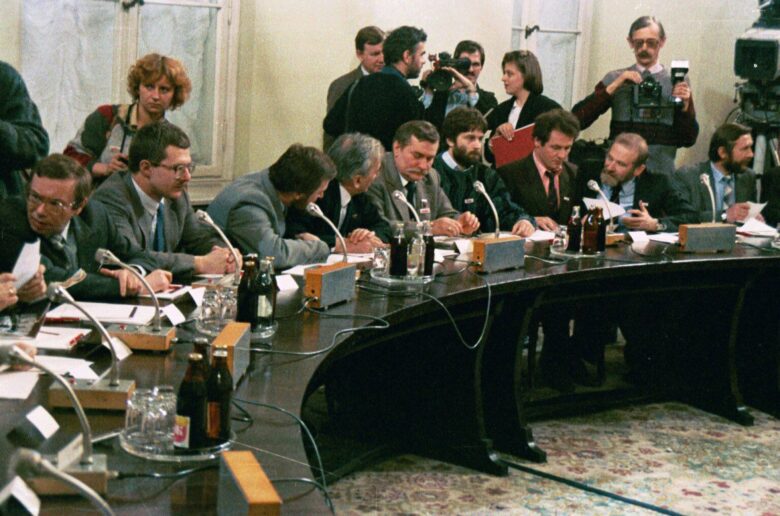
There’s an old newsreel clip I can’t forget: a long table, ashtrays, microphones, faces set in careful calm. No fireworks, no dramatic speeches—just people talking. Yet that quiet scene from early 1989 helped turn a one-party state into a democracy. The Polish Round Table Talks didn’t look like a revolution, but they worked like one. If you’ve ever solved a family crisis at the kitchen table instead of in court, you already understand the magic. You replace force with rules, pride with listening, and stalemate with a plan.
WHAT THE ROUND TABLE REALLY WAS
Between February and April 1989, representatives of the communist government and the opposition linked to the Solidarity movement met in Warsaw to bargain over Poland’s future. The economy was exhausted, shelves were bare, and the public’s patience had worn thin. The opposition had moral authority and social power but lacked legal leverage. The state had laws and police, but no credit with its own citizens. Sitting down together wasn’t a sign of affection. It was a hard choice made by rivals who finally recognized that neither side could steer the country alone.
WHY BOTH SIDES CHOSE TO TALK
I think about it like a business with cash-flow problems and a furious customer base. Management can double down on control, or it can invite key stakeholders into the room. In 1989, both sides saw the cost of “doubling down.” Strikes risked chaos. Repression risked international isolation and more debt. Negotiation offered something better: a controlled landing. For the government, it promised stability and a chance to shape the pace of change. For Solidarity, it promised legalization, free media space, and a path to elections. Realism—not romance—brought everyone to the table.
WHAT HAPPENED IN THE ROOM
Working groups hammered through issues that touch everyday life: pluralism in parliament, the re-legalization of Solidarity, limited but real press freedom, economic reforms, even rules for a new presidency. None of it was total victory. All of it was progress. The agreement created a hybrid system with partly free parliamentary elections, a new upper house elected freely, and a presidency designed to manage the transition. If that sounds messy, that’s because it was. But messiness can be a feature, not a bug, when you’re defusing a decades-long standoff without bloodshed.
THE JUNE 1989 ELECTION THAT CHANGED THE AIR
When Poles voted in June 1989, something electric happened. Candidates tied to Solidarity won a stunning mandate in the seats they were allowed to contest. The result didn’t just fill chairs in parliament; it shifted the nation’s weather. A non-communist prime minister took office. Independent newspapers appeared on kiosks. Conversation spilled from kitchens into public squares. I once asked my aunt what it felt like. She said the streets seemed taller—as if people stood up straighter because the future finally made room for them.
WHAT IT MEANT FOR ORDINARY LIVES
The transformation that followed wasn’t easy. Prices jumped, jobs changed, and the new rules demanded new habits. But inside homes, something gentler took root. People planned five years ahead without a shrug. Entrepreneurs opened shops with real customers, not ration cards. Teachers assigned essays on current events without scanning the hallway first. My neighbor, a mechanic, told me the first time he ordered parts from abroad and they actually arrived on time, he felt like he had stepped through a doorway into a different century. The Round Table made those small miracles possible by putting the state and society back on speaking terms.
A PERSONAL ANECDOTE ABOUT COURAGE WITHOUT DRAMA
My favorite story from that spring comes from a family friend who worked in a state office. She said the day after the agreement was announced, her boss gathered the staff and confessed he didn’t know exactly how things would work next, but he wanted to run the office with openness and fairness until the new structures settled. No slogans, no grandstanding—just a civil servant deciding to behave like a citizen. If the Round Table had a soundtrack, it would be that tone: calm voices choosing responsibility over fear.
PRACTICAL LESSONS FOR TODAY
The Round Table offers a playbook for modern conflicts, whether you’re leading a company, a city, or a classroom. Name the real problems without humiliating your opponent. Trade symbolic wins for structural change that lasts. Write down the rules and live by them even when it hurts. Build in milestones so trust can grow with each step. I’ve seen teams turn around not by firing louder emails, but by scheduling a standing weekly check-in where decisions are documented and shared. That’s Round Table energy—boring in the best way, and surprisingly powerful.
HOW TO MARK THE ANNIVERSARY WITH PURPOSE
If you want the history to stick, don’t just post a quote once a year. Visit a local museum exhibit on 1989 and read one handwritten leaflet from the time. Watch a short documentary with your kids and pause to explain what an election means when it isn’t guaranteed. Call an older relative and ask what changed for them that summer. If you lead a team, try a “Round Table day”: invite the quietest voices to open the meeting and commit to one decision you’ll implement within a week. History becomes real when it changes how we behave on Monday morning.
WHY THIS STORY PLAYS WELL BEYOND POLAND
International readers sometimes ask why the Polish Round Table still matters. Because it proves that peaceful transitions are possible even when trust is low and stakes are high. It shows that dialogue can unlock legitimacy that force can’t buy, and that limited elections can become a bridge to full democracy when citizens are ready to walk across. In an era of sharp online arguments and short tempers, that is a hopeful message: durable victories are built at tables, not on timelines.
ONE SENTENCE TO KEEP
The Polish Round Table worked because rivals sat down, named their interests, wrote rules they were willing to obey, and then let the people choose—proof that quiet courage can move history further than any shout.