A COLD MORNING, A KING AT PRAYER
Imagine a Tuesday morning in July. It is 15 July 1410. The night storm has just passed, the air is cold, the fields are wet, and forty thousand Polish and Lithuanian soldiers are trying to wake up, saddle their horses and move through muddy roads.
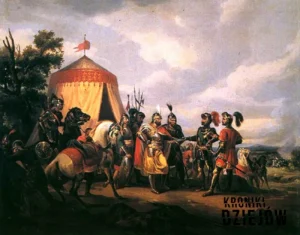
Around eight o’clock the army reaches a small lake near the village of Ulnowo. The sun finally breaks through the clouds. King Władysław Jagiełło orders a stop and, instead of running straight into battle, he does something that sounds almost unreal for a modern mind: he tells his people to set up a tent so he can listen to mass. His scouts already reported that the Teutonic army is close, but the king is calm.
This moment often surprises people. How can a commander stay so peaceful on the morning of the biggest battle of his life? Yet it shows something important about Grunwald. It was not an accident, not a chaotic clash, but the result of a long, carefully prepared campaign and a clear political goal.
FROM “HOLY HELPERS” TO DANGEROUS NEIGHBOURS
At the beginning, the Teutonic Knights were not seen as enemies of Poland. They were invited in the thirteenth century to fight pagan Prussian tribes and protect Mazovia from raids in the north. For a while it looked like a good deal. The Knights built castles, organised crusades and brought warriors from across Europe.
But “temporary help” slowly changed into a powerful state. Instead of a loose group of tribes, on Poland’s northern border a strong, rich and very well organised country appeared. The Teutonic Order collected taxes, built a network of fortresses, and loved war as much as prayer.
They also gained the right to “convert” pagan Lithuanians. In practice that meant regular armed campaigns in the east. At the same time they grabbed Gdańsk Pomerania, attacked Polish lands and used religion as a shield for expansion. What started as cooperation turned into a long and painful conflict.
Many students today feel something similar when they invite a “stronger friend” to help with a problem and end up depending on them. Grunwald is a historical version of that lesson: be careful who you give power to, because getting it back may take generations.
A POLISH-LITHUANIAN ALLIANCE THAT CHANGED THE GAME
Everything shifted when Poland and Lithuania joined forces. The union brought together the Kingdom of Poland and a huge, multi-ethnic Lithuanian Grand Duchy stretching far into today’s Belarus and Ukraine. Suddenly the Teutonic Order had to face not two rivals, but one large bloc.
In 1409 another uprising broke out in Żmudź, a Lithuanian region controlled by the Knights. War became inevitable. During a meeting in Brest, King Jagiełło and Grand Duke Vytautas prepared a bold plan: join their armies and move directly towards Malbork, the Teutonic capital, forcing the Order to accept a decisive battle.
The march itself was a strategic masterpiece. Engineers built a pontoon bridge over the wide Vistula near Czerwińsk so the huge army could cross the river. It is a detail that makes many history teachers smile: medieval soldiers building something that looks very much like a modern military operation. If you have ever planned a big project at work or organised a complex family trip, you know how many small things can go wrong. Now imagine coordinating tens of thousands of people, horses, wagons and supplies – without phones, maps apps or email.
FOUR HOURS THAT SHOOK MEDIEVAL EUROPE
The two armies finally met near the villages of Grunwald, Stębark and Łodwigowo. The Teutonic Knights, with their white cloaks and black crosses, set up camp on slightly higher ground and waited. The Polish-Lithuanian forces stayed hidden behind the woods and hills.
Before the battle, a famous scene took place. Two heralds from the Teutonic side brought Jagiełło and Vytautas two swords, “to help them fight more bravely” and invited them to come out of the forest to face a “real” battle in the open field. It sounded polite, but the message was full of arrogance. The king accepted the swords calmly. Today the “Grunwald swords” are one of the strongest symbols of the battle.
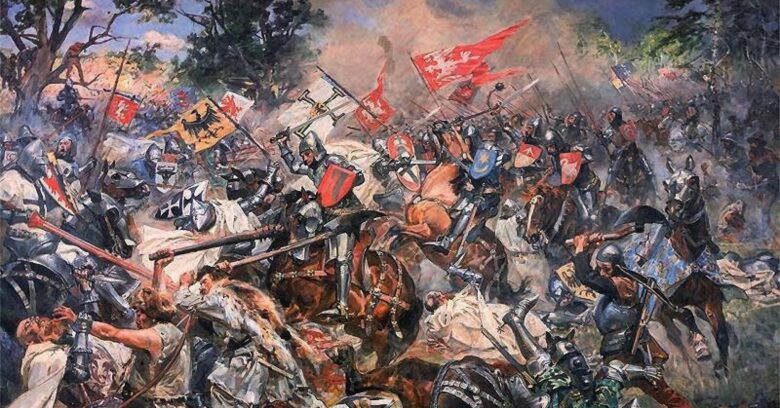
When the armies finally moved, the field turned into four hours of noise, fear and chaos.
The Lithuanian and Ruthenian banners on the right wing started the charge. The Teutonic artillery fired, but early medieval cannons were more smoke and sound than real destruction. Cavalry crashed into cavalry, lances broke, men and horses fell. At some point the Lithuanian forces pulled back, and historians still argue whether it was a panic retreat or a smart trick to stretch the Teutonic lines.
On the Polish left wing, the fight was different but just as hard. Heavy armoured knights met in repeated charges. The white eagle of the main Polish banner disappeared for a moment, causing panic, and then rose again, giving new energy to tired fighters.
The turning point came when Grand Master Ulrich von Jungingen led a group of elite units in a bold attack, hoping to break the Polish formation from the side. It almost worked. His cavalry rode so close to the hill where Jagiełło stood that the king himself had to defend against an attacking knight. But the charge was stopped, the Grand Master was killed, and Teutonic resistance began to collapse.
By late afternoon the battlefield belonged to the Polish-Lithuanian coalition. The Teutonic camp was captured, their leaders dead or in chains, and the myth of the invincible Order shattered.
WHY GRUNWALD STILL MATTERS TODAY
Politically, the peace that followed did not look as spectacular as the victory itself. Malbork was not taken, the Teutonic state survived, and the border moved only slightly. On paper, it might seem like a “wasted” triumph.
In reality, Grunwald broke something much deeper: the psychological power of the Order. From that day, the Knights slowly entered a long decline. To pay war costs and ransoms they raised taxes, angering their own subjects. Decades later, Prussian cities and nobles openly rebelled and asked to join the Polish Crown. Without Grunwald, that would have been hard to imagine.
For modern readers, this story carries a few timeless lessons. Huge changes do not always happen in one dramatic moment. Yes, four hours on the Grunwald fields shook medieval Europe, but the real effects unfolded slowly, in finances, politics and everyday life. The same happens with our personal “battles”: an important exam, a tough business decision or a breakup may last one day, yet its consequences shape years to come.
Grunwald also reminds us that alliances matter. Poland alone could not easily defeat the Teutonic Order. Lithuania alone also struggled. Together they changed the balance of power in the region. It is the historical version of something many people discover only later in life: you do not have to fight every battle alone to be strong.
Today, when families visit the Grunwald battlefield or watch historical reenactments, children usually come for the armour and swords. Adults often stay for something else: the quiet thought that some mornings, even those that start with mud, cold and fear, can end in a way that changes history.