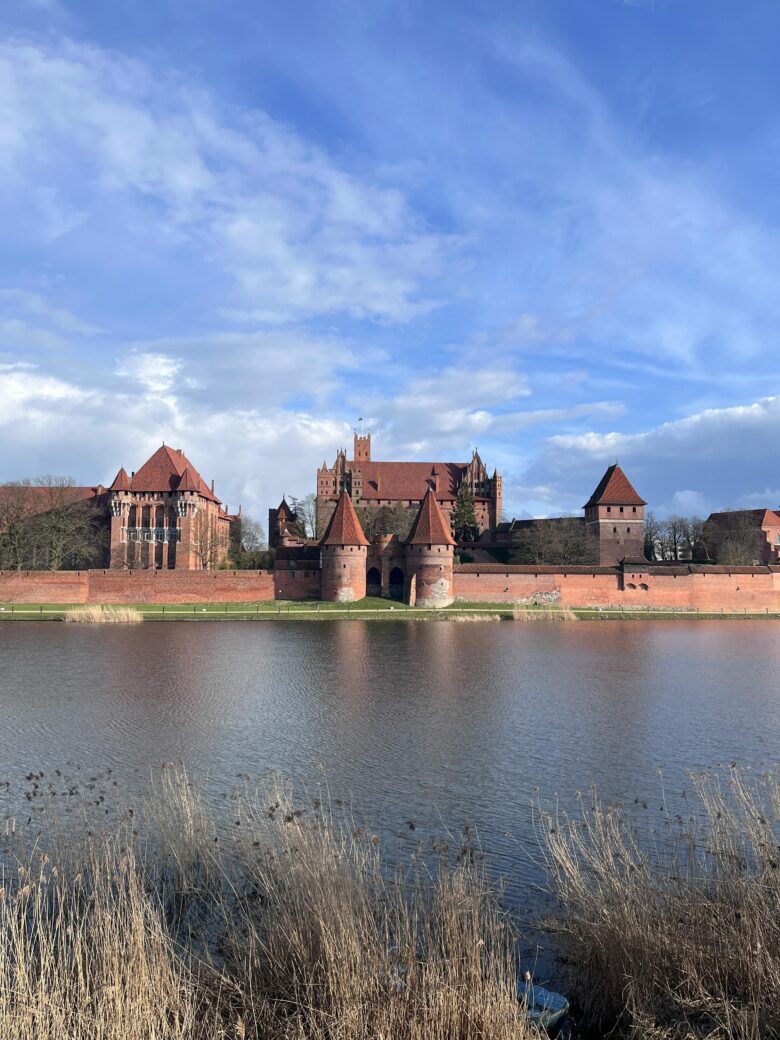
The Castle of Malbork is not just “another tourist attraction.” It’s the kind of place that makes you stop mid-step and take a long breath. The sight of this massive brick fortress rising above the Nogat River feels almost unreal. For a moment, you have the impression that someone quietly turned the clock back a few centuries. No wonder the World Heritage Committee decided in 1997 that this site deserves a place on the prestigious UNESCO list.
A CASTLE ON THE NOGAT THAT STANDS OUT IN EUROPE
Located in northern Poland, Malbork Castle stretches majestically along the eastern bank of the Nogat River. It’s one of the largest Gothic brick castles in the world, and this isn’t just a catchy phrase from a travel brochure. You can see its sheer scale from every angle — whether you’re admiring it from the riverside path or from an aerial view.
The castle was originally built as the headquarters of the Teutonic Order, and its architecture is completely unique. This brick Gothic style didn’t copy Western European or Middle Eastern patterns. It developed independently, shaped by the needs, ambitions, and ideology of the medieval knights who ruled these lands. Standing in the High Castle courtyard and looking up at the arcades, it’s nearly impossible to believe all of this was created without modern tools — only craftsmanship, experience, and determination.
A RELIGIOUS STATE AND THE DARK SIDE OF “HOLINESS”
Malbork Castle is a physical reminder of a political-religious experiment: the monastic state in Prussia. In the 13th century, the Teutonic Knights — warrior-monks — marched north, determined to convert pagan Prussians and Lithuanians. Their mission soon turned into a complex series of wars, conflicts, and political games that also involved Christian Poland.
You can feel this duality everywhere in the castle. There is spirituality — chapels, quiet cloisters, ascetic interiors. But there is also raw military power — thick walls, arrow slits, drawbridges. It’s a symbol of late medieval Christianity, which often tried to merge faith with force, purity with political ambition.
Walking through the chambers and along the fortified corridors, you’re confronted not only with architectural beauty but also with the real, often brutal, history of this region.
FROM ROMANTIC FASCINATION TO POST-WAR REBIRTH
By the 18th century, Malbork had already become an object of fascination for artists and early historians captivated by the medieval past. The castle was treated almost like a stage set for stories of knights, crusades, and heroic battles. Later, different governments began using it to build political narratives, making it a powerful symbol — sometimes idealized, sometimes manipulated.
In the 19th century, massive conservation work began. Malbork turned into a kind of open-air laboratory for restoring historic monuments. Specialists revived medieval techniques, studied ancient masonry, and set standards for protecting heritage across Central and Eastern Europe.
World War II brought devastation. The castle was heavily damaged, and for many people in post-war Poland, its reconstruction was more than a technical challenge. It was a symbolic act — a way to rebuild continuity, reclaim history, and show that even ruins can rise again. Malbork’s rebirth became a testament not just to skill, but to resilience.
WHY UNESCO RECOGNIZED MALBORK
Being added to the UNESCO World Heritage List isn’t a prize for “a pretty building.” It’s recognition that a site carries value for all of humanity. Malbork meets several essential criteria.
First, it’s a masterpiece of brick Gothic architecture. The solutions created by the Teutonic builders — from structural innovations to decorative details — influenced other castles and churches throughout the region. Malbork wasn’t following trends; it was setting them.
Second, it’s a powerful symbol of the Teutonic State. As the capital of a monastic-military power, the castle witnessed decisions that shaped the entire Baltic region. Today, we read its walls like historical documents — full of conflict, faith, ambition, and transformation.
Third, it is a landmark of historic conservation. The many phases of restoration reveal how approaches to preserving heritage evolved from the 19th century to modern times. Malbork is a monument not only to the medieval world, but also to the very idea of protecting cultural memory.
MALBORK TODAY — A LIVING LESSON IN HISTORY
Today, Malbork Castle is full of life. In summer, the castle hosts battle reenactments, knight shows, concerts, markets, and family events. It’s a place where the past becomes part of an exciting experience, not just something trapped behind museum glass.
Imagine walking across the drawbridge, stepping through the gate, and suddenly standing in a vast courtyard enclosed by towering walls and stone staircases. Everything echoes — footsteps, voices, the wind brushing along the bricks. You feel small, but also incredibly curious. Each corner hides another story: the kitchen of the monastic community, the chapter house, the church, the cool corridors that once bustled with daily life.
If you’re planning a trip through Poland, Malbork should be on your shortlist. It’s perfect for families, history enthusiasts, couples on a weekend getaway, and anyone who wants to feel something more than just tourist fatigue. For kids, it’s like stepping inside a fantasy movie. For adults, it’s a reminder of how complex, dramatic, and fascinating European history really was.
Malbork Castle proves that the past doesn’t have to be boring or silent. When shown with care, it becomes a story you can walk through — a story that moves, inspires, and teaches. And that is exactly why the World Heritage Committee recognized Malbork in 1997 — and why it continues to captivate every generation that walks through its gates.