LEGENDS THAT GROW UP WITH US
Every country has its own stories that children grow up with, but in Poland legends are almost like an extra member of the family. They appear at bedtime, in school readers, at grandparents’ homes, on school trips and family holidays. They explain where cities came from, why certain places are important and what happens when people become greedy, cruel or too proud.
A legend is not just a fairy tale. It usually has a small grain of truth hidden somewhere inside. There may be a real place, a historic ruler, a true event in the background. The magic, dragons and devils help children remember the message much better than a dry history lesson. And that is exactly why these five Polish legends are still told today — and why every child should hear them at least once.
LECH, CZECH AND RUS – HOW A WHITE EAGLE FOUND ITS HOME
The legend of Lech, Czech and Rus is often the first “big” story about the beginnings of Poland that children hear. Three brothers lead their people in search of new lands. One brother, Rus, stays on the wide steppes. The second, Czech, chooses the sunlit mountain. The third, Lech, keeps walking until he finds rich forests, rivers full of fish and fertile fields.
At that moment a white eagle lands on an old oak tree. Lech decides to settle there, creates a settlement in the shape of an eagle’s nest and calls it Gniezno. The white eagle later becomes the symbol of Poland.
For a child, this is not just a geography story. It is a tale about leadership and courage. Parents often use it in simple ways, for example when a child changes school or moves to a new city. You can say: “Lech was also afraid when he walked into the unknown, but thanks to that he found his true home.” It gives a sense of continuity and pride in Polish roots.
PRINCE POPIEL – WHY GREED ALWAYS COMES BACK
The legend of Prince Popiel is darker, but very powerful. Popiel is a ruler who cares only about pleasure. He ignores his duties, treats his people badly and, with his wife’s help, gets rid of his own relatives to keep all power and wealth to himself.
Soon, thousands of mice start to appear around his castle. They follow him even to a tower on an island and finally destroy him. The old tower by Lake Gopło is still called the Mouse Tower as a reminder of his punishment.
With children, adults usually soften the details, but the lesson is clear. You cannot build happiness on the suffering of others. Many parents turn this legend into a simple everyday message: when a child refuses to share toys or sweets, they joke, “Careful, or the mice will come for Popiel number two.” It brings a smile, but also reminds that selfishness always has a price.
THE WAWEL DRAGON – WHEN SMART IS STRONGER THAN SCARY
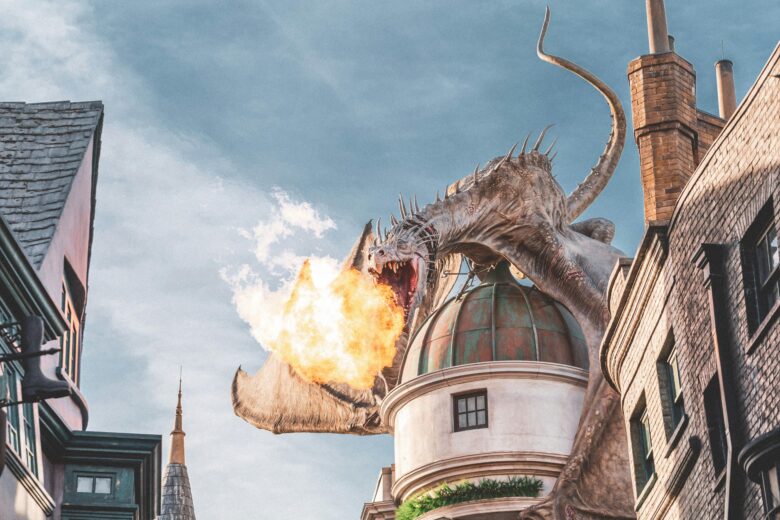
The Wawel Dragon is probably the most famous Polish legend worldwide. Under Wawel Hill in Kraków a terrifying dragon lives in a cave. Knights try to kill it and fail, people leave the city, and fear grows. Then a simple shoemaker’s apprentice named Skuba comes up with a plan. He fills a fake sheep with sulfur, the dragon eats it, becomes incredibly thirsty, drinks so much water from the river that it bursts and dies.
Children love this story because the hero is not a muscular warrior in shining armour, but a normal boy with a clever idea. It is a perfect legend to tell when a child is afraid of something big — a test, a competition, the first day in a new class. You can say: “You don’t have to be the strongest. Like Skuba, you just need your own way to solve the problem.”
And if you ever visit Kraków with your child, standing near the real Dragon’s Den and connecting the place with the legend makes the story unforgettable.
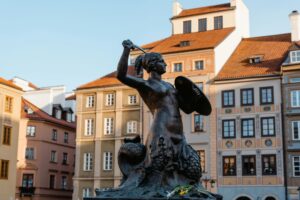
THE WARSAW BASILISK – COURAGE, FEAR AND A SHINING SHIELD
In old Warsaw, according to the legend, there was a haunted house on Krzywe Koło Street. People believed that whoever entered its basement, never came back. One day two children follow a travelling performer into the building and discover a terrible creature: a basilisk, half snake and half rooster, that turns people into stone with one look.
Their father, a skilled armourer, rushes to save them. He puts on his best armour, takes a shield polished like a mirror and goes down to the basement. When the basilisk jumps out and looks at him, it sees its own reflection and turns itself into stone.
This legend is perfect for showing that fear can sometimes be beaten with preparation and a good plan. Many parents use it as an example when a child is nervous about going to the dentist, taking part in a school play or speaking in front of the class. “Let’s polish your ‘shield’ first,” they say, meaning: let’s talk, practise and prepare. Suddenly, the scary situation becomes easier to handle.
MR TWARDOWSKI – A DEAL WITH THE DEVIL AND A LESSON IN WISDOM
The story of Mr Twardowski is one of the most magical Polish legends. A nobleman fascinated by science and magic makes a deal with the devil. In exchange for his soul, he gets the power to perform amazing miracles. He heals people, travels on a giant rooster and even calls back the spirit of the late queen for the king.
He adds a clever condition to the contract: the devil can take him only in Rome. Twardowski never plans to go there. But one day he walks into an inn called “Rome” and discovers too late that the devil has tricked him.
There are many versions of what happens next, but the most popular one says that Twardowski starts praying so strongly that the devil loses his strength and drops him on the Moon. According to legend, he still sits there and looks down at Earth.
This legend is a great way to talk with older children about quick promises and “easy shortcuts”. It shows that trying to win everything without effort usually ends badly. At the same time, it leaves a bit of poetic charm — the idea that on clear nights you can look at the Moon and imagine a lonely sorcerer sitting there, thinking about the choices he made.
WHY THESE LEGENDS STILL MATTER TODAY
In a world of streaming platforms and fast cartoons, it may seem that old stories cannot compete. Yet Polish legends survive because they speak to emotions that never go out of date: fear, courage, jealousy, love, greed and hope.
Reading or telling them to your child is more than just entertainment. It is an easy way to smuggle in history, geography and values. You can connect them with real trips, like visiting Kraków, Gniezno or Warsaw, or with small daily situations, like learning to share or facing a fear.
Most of all, these legends give children something very important: the feeling that they are part of a longer story. Long before they were born, people told these tales by candlelight. Now it is your turn to pass them on — maybe in a modern bedroom, with a lamp and a cup of hot cocoa, but with the same magic in the words.