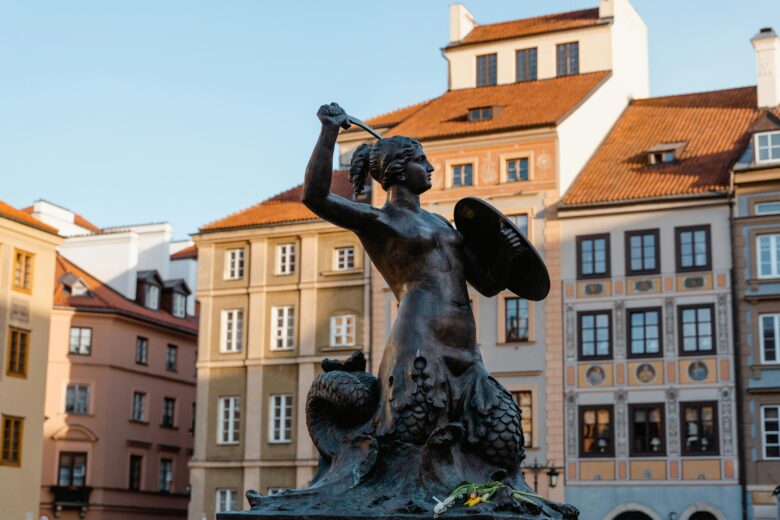
A friendly hello from the “Mermaid City”
Warsaw is often called the Mermaid City for a reason. The Syrenka Warszawska sits on the city’s coat of arms, glows on street lanterns, and watches the Vistula from more than one pedestal. But beyond the postcards there’s a living story. The legend mixes a bit of sea-salt, a little street grit, and a promise to protect the people who live here. I first heard it from a taxi driver on a rainy evening; he pointed at the river and said, “If you listen, you can almost hear her sing.” Corny? Maybe. But it stuck with me.
Where the symbol came from, in simple words
Medieval towns loved symbols. When Warsaw was still a small riverside settlement, locals chose a mythic guardian to stand for courage and care. Early seals show a strange mix of creature parts, like a half-griffin with a shield. Over the centuries the image softened into the mermaid we know today: a woman with a fish tail, a round shield in one hand and a raised sword in the other. She looks to the right as if scanning the river for trouble. It’s not just decoration. It’s a short, visual sentence that says, “I will defend this place.”
The legend everyone tells, and why it still works
One version says two sisters swam from the Atlantic into the Baltic. One stopped in Copenhagen. The other followed the Vistula upstream, climbed onto a sandy bank near what is now the Old Town, and fell in love with the light and the noise of fishermen at work. She teased them by stirring waves and freeing fish from nets, but when they heard her voice, nobody stayed angry. A greedy trader captured her to sell on fairs. A young fisherman heard her crying, cut the ropes, and set her free. Grateful, she promised to guard Warsaw forever. That’s why she holds a shield and sword. It’s not a war pose; it’s a neighbor’s vow.
This small story carries a big idea. The city protects those who protect each other. It’s the same vibe you feel when a stranger helps you carry a stroller up a tram stair, or when a café keeps a lost glove on the counter for a week. Legends survive because they explain daily life with simple pictures.
How the mermaid shows up around town
You don’t need a map to see her, but here’s how to meet the three best-known mermaids without turning your day into a scavenger hunt. Start in the Old Town Market Square. In the center stands a compact statue, almost two meters tall. She looks like she is rising from splashy waves, sword lifted, shield forward. On a warm evening there are kids with ice-cream around her feet and buskers in the corners. If you want a quiet moment, come early. The square smells like fresh bread before the tour groups arrive.
Walk down to the Vistula boulevards and you’ll find a taller mermaid in bronze. Her sword points to the skyline, and behind her the water shifts color with the weather. Joggers pass, cyclists ring their bells, and the wind off the river makes the whole scene a little cinematic. I once waited out a summer storm under that pedestal, and when the rain broke the statue looked like it had just climbed out of the river for real.
A third mermaid greets you near the Markiewicz Viaduct, not far from the grand hotels and the slope that falls to Powiśle. This one is part of a sculptural group that mixes city symbols with human figures. The traffic hums overhead, but if you stand a few steps away you get a quiet frame that feels almost theatrical.
A short note on the city’s coat of arms
Since the late 1930s Warsaw’s official coat of arms shows the mermaid on a red shield, crowned, sword raised. Designers will argue fonts all day, but almost nobody argues the mermaid. She has that tidy balance of beauty and purpose. Kids draw her in school. Football fans print her on scarves. Street artists remix her tail with neon. That’s how you know a symbol is alive—it keeps finding new shapes without losing the heart.
What the story can teach right now
It’s tempting to file legends under “nice for kids.” But look a bit closer. The mermaid rewards courage and kindness. The young fisherman acts even when the problem feels too big for one person. That’s useful for grown-ups making daily choices in a fast, noisy city. Hold the door, step in when someone needs help, learn your neighbor’s name. It’s small, but small actions scale. I once left my backpack on a bench by the river—real smart, I know—and a teenager chased me two blocks to return it. He just shrugged and said, “That’s what we do here.” That’s a mermaid moment if you ask me.
Planning your own “mermaid walk”
If you want a light route, start at the Old Town statue just after breakfast, when the cobbles are still damp and the air is cool. Take fifteen minutes to soak the scene rather than just snap a photo. Walk down the Royal Route and cut toward the river. Follow the boulevards until you reach the big bronze mermaid by the water. Sit on the steps, let your legs dangle, and watch the ferries slide by. If you still have energy, head toward the viaduct and find the third statue tucked into its stone stage. Bring a bottle of water in summer and a scarf in spring; the river winds are honest. And don’t stress if you mis the turn once or twice. Getting a little lost is part of meeting a city.
For parents and curious minds
Tell the legend in your own words as you walk. Ask kids what the mermaid might be guarding today. Is it the bridges? The libraries? The bakeries that open before sunrise? Let them invent an ending. If you’re a history fan, notice how the image changed through the ages, from a fierce half-beast on early seals to today’s more human protector. Those shifts track the city’s changing self-portrait without needing a textbook.
Final thoughts from the riverbank
The Syrenka Warszawska isn’t just marble and metal. She’s a way to talk about belonging, bravery, and everyday care. Whether you’re here for one afternoon or you’ve lived in Warsaw your whole life, look up when you cross the Vistula. The sword in the air is a reminder to stand tall, and the shield says look out for one another. That’s a lengend worth keeping, even if we spell it a bit funny sometimes. And if you catch a breeze that sounds like singing, don’t worry—you’re just hearing the city breathe.