The date that began a country
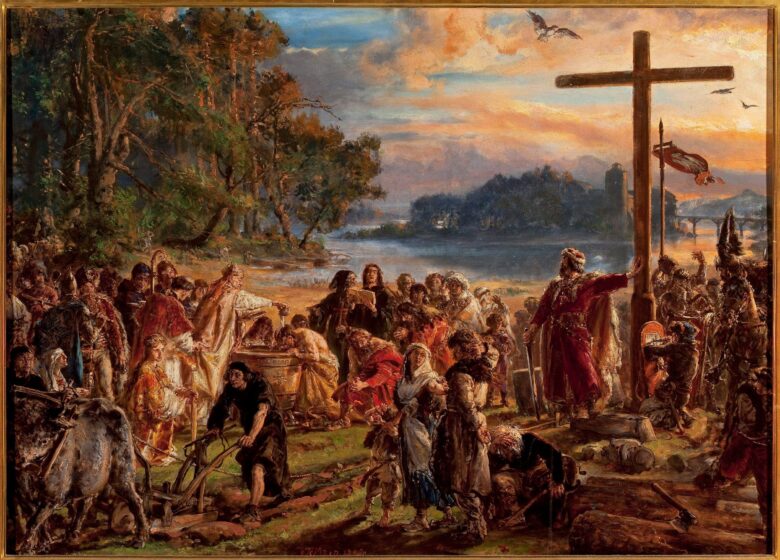
When you see the number 966, it looks like a neat pin on a timeline, but real life is messier. Historians treat the baptism of Mieszko I and his court as the symbolic beginning of Polish statehood, most likely celebrated on Holy Saturday around April 14, 966. It wasn’t a mass conversion of every village overnight. Pagan customs lingered for generations, sometimes into the fourteenth century and beyond. What changed immediately was the status of the ruler and his realm. By receiving baptism, Mieszko stepped into the circle of Christian princes, speaking the same political language as his neighbors and unlocking a new level of diplomatic credibility.
Politics before piety—though faith mattered too
I remember explaining this to a friend over coffee: imagine you’re running a fast-growing startup surrounded by giants. You can try to stay fiercely independent, or you can join the dominant network and gain protection, capital and standards. Baptism was, in this sense, Poland’s onboarding to the Western system. As a Christian ruler, Mieszko’s authority gained a sacred seal recognized across courts. His wars against still-pagan rivals could be framed not just as expansion, but as legitimate consolidation under a Christian prince. None of that cancels sincere faith, but it shows why the decision was also a masterclass in statecraft.
A marriage that rewired the map
The story often starts one year earlier with a wedding. Mieszko married Dobrawa, a Christian princess from Bohemia, in 965. Chroniclers from Thietmar to Gallus Anonymous credit her influence in nudging the prince toward baptism. Whether you see this as romance, diplomacy, or both, the marriage built a bridge to the Christian world at exactly the right time. I like to think of Dobrawa as the person who introduced Poland to the room where decisions were made, and once inside, Mieszko understood the opportunity clearly enough to commit.
Where the water met the crown
Scholars debate the exact location, but the island stronghold of Ostrów Lednicki between Gniezno and Poznań is a compelling candidate. Archaeologists uncovered the remains of a palatium and a sizeable baptismal font, big enough for an adult. The first time I stood by the ruins, wind gusting over the lake, the scene felt surprisingly modern. You could picture a leader hosting a well-staged, high-signal event, surrounded by clergy and nobles, signaling to allies abroad that Poland had chosen its future. Whether the rite happened there or in another Piast center, the message traveled far beyond the shore.
From rite to institutions—why structures mattered
A single ceremony doesn’t build a state, but it can start the engine. Within two years, by 968, a missionary bishopric was created in Poznań under Bishop Jordan. Three decades later, in the year 1000, the archbishopric of Gniezno took shape, with subordinate bishoprics in Kołobrzeg, Kraków and Wrocław. Those aren’t just church addresses; they were the backbone of administration, literacy and law. Monasteries and chapters kept records, trained scribes, ran schools and connected local elites to Europe-wide networks of knowledge and commerce. If you’ve ever tried to scale a small business into a durable company, you know the leap from charisma to structure is everything; the Church, in this context, was Poland’s organizational operating system.
What the old books actually say
We don’t possess a press release from 966. Instead, we piece the story together from medieval writers and annals compiled years later. Thietmar of Merseburg, writing roughly half a century on, describes Dobrawa’s steady campaign to bring her husband to the Christian faith and the subsequent conversion of the court. Gallus Anonymous adds color about Mieszko’s earlier pagan customs and the decisive break that marriage and baptism represented. Later chroniclers—Wincenty Kadłubek, Jan Długosz—and various annals, including the Kraków chapter’s record, reinforce the outline: marriage in 965, baptism in 966, and the rapid alignment with Europe Christiana. The sources don’t agree on every detail, but they converge on the essentials and, taken together, paint a coherent picture.
A holiday with modern meaning
Since 2019, Poland officially marks the Feast of the Baptism of Poland on April 14. I like that the date now lives both in textbooks and in the calendar. It’s an annual nudge to think about belonging. For many, it’s a religious celebration. For others, it’s a civic reminder of the moment we stopped being a patchwork of tribes and started speaking with one voice. However you approach it, the anniversary invites a simple question that resonates far beyond history class: what does it mean to choose your community?
How 966 speaks to us today
A few summers ago I visited Gniezno with a notebook and a cheap pen that kept blotting the page. I scribbled a line I still come back to: “Integration beats isolation when the world is moving fast.” Mieszko didn’t wait to be coerced by foreign powers. By choosing baptism proactively, he dodged the risk of forced Christianization and positioned his realm as a partner rather than a project. There’s a practical lesson here for business, policy and even family life. Choose your frameworks intentionally, before circumstances choose them for you. Build alliances that lift your goals. Invest in institutions, not just moments.
Bringing the story into everyday life
If you want to make 966 tangible, start with places. Walk the island at Ostrów Lednicki and let the silence work on you. Stand by Gniezno Cathedral and picture the Congress of Gniezno in the year 1000 and the birth of an archbishopric that connected Poland to the heart of Latin Christendom. Back home, put April 14 on your calendar and make it a quiet ritual. Share the story with a child over Sunday lunch, not as a dusty date, but as a decision by a leader who understood leverage. Tell them that big changes rarely feel cinematic while they’re happening; they feel like a choice, made on a specific day, that sets a direction for centuries.
The answer in one sentence
So why did Mieszko I accept baptism? Because in a single, calculated and meaningful act, he aligned his people with the most powerful cultural, legal and diplomatic network of his age, turned fragile power into recognized sovereignty, and opened the door for Poland to grow from a frontier principality into a European state.